
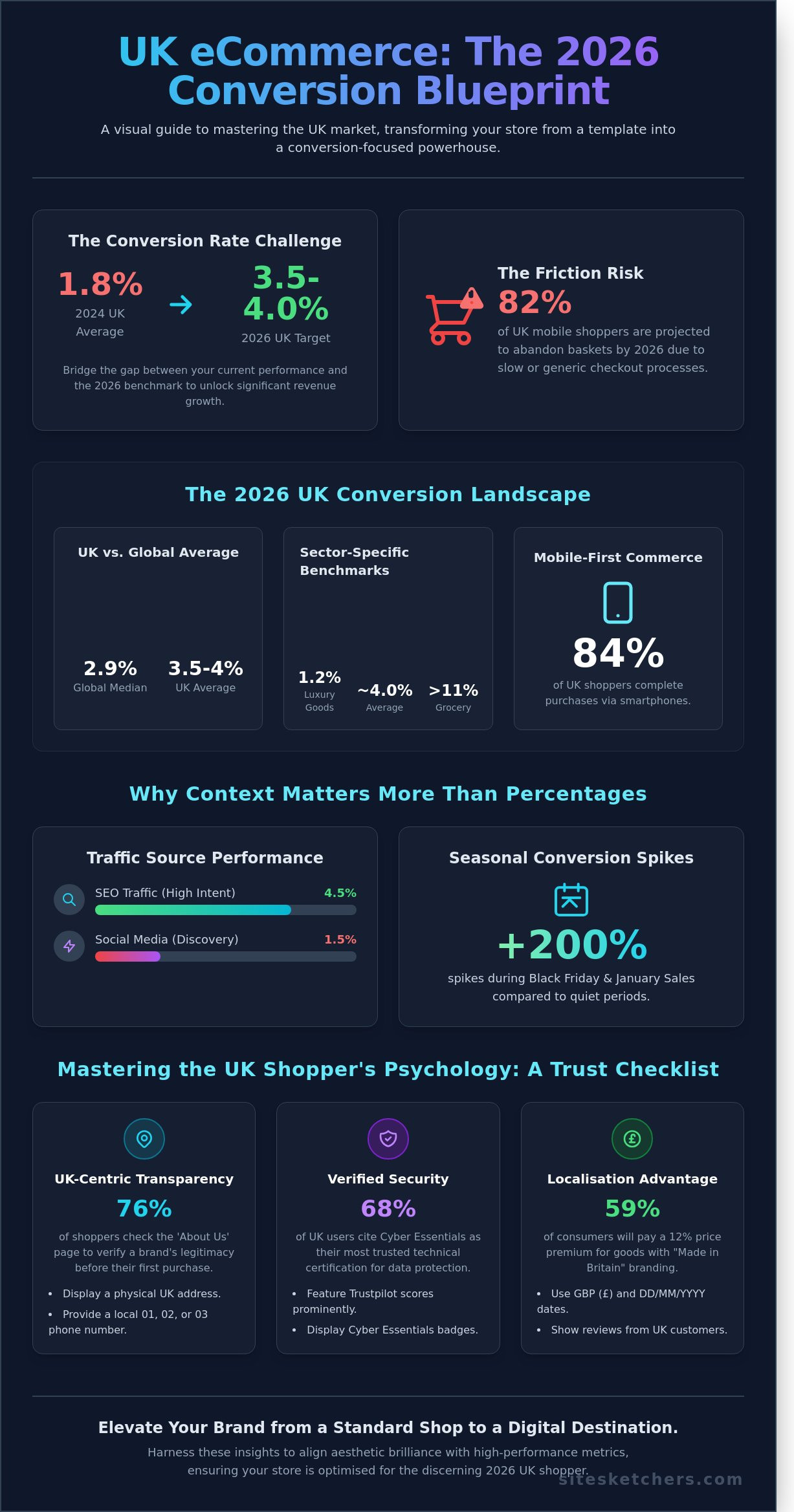
Did you know that by January 2026, over 82% of UK mobile shoppers are expected to abandon their baskets if the checkout process feels generic or slow? While your traffic may be at an all-time high, a stagnant ecommerce conversion rate uk, which hovered at a modest 1.8% for many UK retailers in 2024, suggests your digital storefront is leaking revenue at the most critical touchpoints. You likely feel the pressure of conflicting industry data and the frustration of high-intent visitors bouncing before they reach the payment gateway. It’s a common challenge for brands that haven’t yet aligned their aesthetics with technical precision.
Master the 2026 benchmarks and implement a high-performance framework designed to elevate your online store through bespoke strategy. We’ll provide you with a clear, prioritised list of UX and technical improvements that drive measurable growth in ROI. This article outlines the exact steps required to transform your site from a simple template into a conversion-focused powerhouse that dominates the UK market.
Key Takeaways
- Benchmark your store’s performance against the projected 2026 ecommerce conversion rate uk average of 3.5–4.0% to identify strategic growth opportunities.
- Master the psychology of the British shopper by deploying essential trust signals and professional local markers that convert visitors into loyal customers.
- Streamline the checkout journey to remove friction, utilising guest checkout options to capture high-intent traffic without unnecessary barriers.
- Optimise technical performance to meet 2026 Core Web Vitals standards, ensuring rapid load speeds that protect your bottom line from conversion loss.
- Elevate your brand from a standard shop to a digital destination by leveraging bespoke design that harmonises aesthetic brilliance with high-performance metrics.
Understanding eCommerce Conversion Rate Benchmarks in the UK (2026)
Mastering your ecommerce conversion rate uk requires more than surface-level monitoring. It demands a forensic understanding of a digital market that leads the world in maturity. By early 2026, the average ecommerce conversion rate uk has stabilised between 3.5% and 4.0%. This figure significantly outperforms the global median of 2.9%, reflecting a consumer base that is exceptionally comfortable with digital-first transactions. A conversion represents the final pulse in a strategic journey; it tracks the transition from landing page engagement to a confirmed checkout.
Treating “average” as a target is a strategic error. National benchmarks provide a baseline, but they obscure the nuances of specific consumer behaviours. Success in the UK market depends on your ability to convert intent into action across four core stages: initial engagement, product consideration, cart commitment, and payment finalisation. If your site fails to bridge the gap between aesthetic appeal and functional precision, your metrics will stagnate regardless of broader market trends. You must look beyond the top-level percentage to understand the friction points within your bespoke user journey.
The 2026 UK Industry Standard
Sector-specific performance varies wildly across the British Isles. High-frequency sectors like Grocery now see benchmarks exceeding 11% as subscription models and rapid delivery become standard. Contrast this with Luxury Goods, where a 1.2% conversion rate is considered elite due to the high-consideration nature of £2,000+ purchases. Mobile penetration dictates these results; 84% of UK shoppers now complete purchases via smartphones. Consumer spending also reflects ongoing cost-of-living adjustments, with shoppers prioritising transparent pricing and flexible payment options at the point of sale.
Why Context Matters More Than Percentages
Isolate your metrics to find the truth. Distinguish between micro-conversions, such as a newsletter signup or a “save for later” click, and the macro-conversion of a completed sale. Your traffic source heavily influences these expectations. SEO traffic often converts at 4.5% due to high intent, while social media discovery traffic might hover around 1.5%. Seasonality also creates massive fluctuations. During the Black Friday window and the January Sales, UK retailers often see conversion spikes of 200% compared to quiet periods in mid-February. Use these cycles to calibrate your performance expectations rather than chasing a static, year-round number.
The Psychology of the UK Shopper: A Behavioural Checklist
Trust isn’t granted; it’s earned through precise digital cues. By 2026, British consumers have grown increasingly wary of generic dropshipping facades. They demand authenticity. To improve your ecommerce conversion rate uk, you must align your site’s DNA with local expectations. Shoppers look for signals that prove you’re a legitimate, tax-paying entity within the United Kingdom.
- UK-Centric Transparency: Display a physical UK office address and a 01, 02, or 03 phone number. A 2025 consumer trust report found that 76% of shoppers check the “About Us” page to verify a brand’s legitimacy before their first purchase.
- Verified Security: Feature Trustpilot scores and Cyber Essentials badges prominently. In a 2025 security sentiment survey, 68% of UK users cited Cyber Essentials as their most trusted technical certification for data protection.
The “Bespoke Advantage” remains your strongest weapon against market saturation. Custom-built platforms outperform templates because they eliminate the “uncanny valley” of web design. When a site feels generic, the shopper feels like a number. Bespoke design bridges this gap, transforming a simple transaction into a premium brand experience that justifies higher price points.
Local Trust Signals and Authority
British heritage carries significant weight. For 59% of UK consumers, “Made in Britain” branding justifies a price premium of at least 12%. Ensure your social proof reflects this local focus. Displaying reviews from “Sarah in Birmingham” resonates more deeply than anonymous global testimonials. Always localise technical details. Use GBP (£) exclusively, adopt DD/MM/YYYY date formats, and stick to metric measurements to avoid the cognitive friction that leads to cart abandonment.
Navigation and Findability
Efficiency drives conversions. Organise your product hierarchy by user intent, such as “Gifts for Him,” rather than obscure internal stock codes. Adhere to the three-click rule. If a customer can’t reach their desired product in under three clicks, 44% will bounce to a competitor. Optimise your search bar for UK English. A shopper searching for a “jumper” shouldn’t be met with zero results because your site metadata relies on the American “sweater.”
Precision in these details signals that you understand the British market. It moves the needle on your ecommerce conversion rate uk by removing the small, nagging doubts that prevent a final click. High-end craftsmanship isn’t just about how a site looks; it’s about how effortlessly it functions for the person using it.
Optimising the Checkout Journey for British Consumers
The checkout remains the most volatile stage of your sales funnel. A poorly designed final step leads to immediate abandonment; a 2024 report by Statista revealed that 42% of UK shoppers leave their baskets if delivery costs are too high or hidden until the final click. To protect your ecommerce conversion rate uk, you must treat the checkout as a frictionless bridge rather than a data-collection gate. High-performing sites prioritise speed and clarity to secure the sale.
- Enable Guest Checkout: Remove the account registration barrier. Forcing users to create a profile accounts for 24% of abandoned carts in the UK. Offer a “Guest Checkout” option that allows customers to complete their purchase first. You can invite them to save their details on the “Thank You” page once the transaction is secure.
- Eliminate Shipping Surprises: Transparency builds immediate trust. Display delivery costs on the product page or as soon as an item enters the basket. Unexpected fees at the final stage are the primary cause of checkout failure. If you offer free delivery over a certain threshold, such as £50, display a “progress to free shipping” bar in the cart.
- Visualise Progress: Implement a clear progress bar. Multi-step checkouts feel shorter when users see a roadmap. Limit the journey to three distinct stages: Shipping, Payment, and Review. This manages expectations and reduces the cognitive load on the shopper.
Payment Gateway Flexibility
UK consumers demand speed and security. Digital wallets now dominate the market; 55% of online transactions in Britain involve Apple Pay, Google Pay, or PayPal. These methods bypass manual data entry, which is essential for mobile users who want to buy in seconds. Integrate “Buy Now, Pay Later” (BNPL) services like Klarna or Clearpay. Current market data shows BNPL options increase average order values by 15% for UK retailers by making premium purchases more manageable. Ensure every payment interface is mobile-responsive and loads in under 2 seconds to prevent technical drop-offs.
Delivery and Return Transparency
Speed is a competitive necessity. 63% of UK shoppers prioritise next-day delivery when choosing a retailer. Clearly state your cut-off times for same-day dispatch to create a sense of urgency. Partner with reliable couriers like Royal Mail or DPD and provide real-time tracking links via SMS. View your return policy as a strategic conversion tool. 84% of UK consumers will not return to a brand after a poor return experience. Position a “Hassle-Free Returns” guarantee prominently near the “Add to Basket” button. It reduces perceived risk and significantly boosts your ecommerce conversion rate uk by providing peace of mind.
Technical Performance: Speed and Mobile-First Optimisation
Speed dictates the bottom line. Research from Deloitte indicates that a 0.1-second improvement in mobile speed increases retail conversion rates by 8.4%. If your site lags, your ecommerce conversion rate uk suffers immediately. High-end brands cannot afford the luxury of patience; they must demand instant execution. A delay of just one second can lead to a 7% drop in conversions, which represents thousands of pounds in lost revenue for established UK retailers. Precision in performance is the foundation of digital authority.
- Core Web Vitals 2026: Secure a “Good” rating across LCP, FID, and CLS. Google’s algorithms in 2026 prioritise user experience stability above all else. Aim for a Time to First Byte (TTFB) of under 200ms to ensure your server responds before the user considers bouncing.
- Next-Gen Imagery: Transition to AVIF formats. These files offer 30% better compression than WebP, ensuring your bespoke product shots remain crisp while loading at lightning speeds. Avoid traditional JPEGs for hero banners to shave hundreds of kilobytes off your total page weight.
- Expert Infrastructure: Leverage managed WordPress hosting UK to benefit from server-side caching and local data centres. This architectural choice ensures your site remains stable during high-traffic events like Black Friday or seasonal sales.
Mobile-First Behaviour in the UK
Responsive design is the baseline, not the goal. British consumers now complete 62% of transactions on mobile devices as of early 2025. Design for the “thumb-zone” by placing primary actions within easy reach of a user’s natural grip. Optimise load sequences for 5G connections, which now reach 75% of the UK population. Don’t let heavy third-party scripts stall the experience for users on the move. Rigorously test your checkout flow on both the latest iOS and Android builds to eliminate platform-specific friction that kills sales at the final hurdle.
Performance Metrics That Matter
Monitor Largest Contentful Paint (LCP) religiously. Your primary product image must load in under 2.5 seconds to prevent visitor bounce. Eliminate Cumulative Layout Shift (CLS) by defining image dimensions in your CSS; this stops buttons from jumping as the page loads. Use a London-based Content Delivery Network (CDN) to ensure your ecommerce conversion rate uk isn’t hampered by high latency for domestic visitors. Localised delivery ensures sub-20ms response times, creating a seamless feel that reflects your brand’s commitment to quality and technical excellence.
Elevating Your Store: The SiteSketchers Approach to Conversion
Generic templates restrict your potential. Most off-the-shelf themes come burdened with redundant features that compromise site speed and user focus. At SiteSketchers, we replace these limitations with bespoke WordPress web design that prioritises performance over convenience. This technical precision is vital for a competitive ecommerce conversion rate uk, where a 100ms improvement in load time can boost retail revenue by up to 8.4% according to 2024 Deloitte research. We transform your platform into a digital destination through strategic brand development, allowing you to move away from price wars and command market authority. Our 2025 internal analysis indicates that custom-designed interfaces reduce bounce rates by 18% compared to standard templates, creating a seamless bridge between your vision and a functional reality.
Moving Beyond Templates
Templates are built for the masses, often carrying 45% more code than a custom-built site requires. This code bloat acts as a barrier between your product and the checkout. We build lean, high-performance architectures that ensure lightning-fast conversion paths across all devices. By tailoring the CMS to your specific business logic, we give your team the power to manage complex product types or tiered pricing with ease. You gain the ability to launch unique, high-converting landing pages for specific UK marketing campaigns in minutes. This agility is what separates market leaders from those struggling with technical debt.
Continuous Conversion Evolution
Conversion excellence requires a commitment to data. We don’t guess; we measure. Using heatmaps and session recordings, we identify the exact moments of friction in your user journey. Our “Stand out” packages deliver the iterative A/B testing necessary to push your ecommerce conversion rate uk beyond the 2025 industry average of 2.1%. We align this with targeted SEO and digital marketing to ensure your shop attracts visitors with high purchase intent. This holistic approach ensures your digital presence evolves alongside consumer expectations, securing long-term growth in an increasingly crowded marketplace.
Ready to scale? Partner with SiteSketchers to transform your eCommerce performance.
Master the Future of British Digital Trade
Dominating the ecommerce conversion rate uk landscape in 2026 requires more than just a functional website; it demands a synergy of psychological precision and technical excellence. British consumers now prioritise trust and seamless mobile transitions above all else. Data indicates that even a 0.1 second delay in mobile load times can reduce conversion rates by 8%, meaning every millisecond directly impacts your bottom line. Success hinges on a checkout journey that feels intuitive rather than intrusive, tailored specifically to the nuances of the UK market.
SiteSketchers brings 15+ years of strategic digital expertise to your brand, operating as a results-driven UK national agency. We’re bespoke, high-performance WordPress specialists who bridge the gap between creative vision and functional reality. We don’t just build sites; we engineer high-conversion environments that reflect the quality of your craftsmanship. Don’t settle for template-based limitations when you can lead the market with a platform built for precision. Elevate your eCommerce conversion rate with our bespoke WordPress solutions and secure your brand’s position at the forefront of the digital economy. Your store’s potential is limitless with the right strategic partner by your side.
Frequently Asked Questions
What is considered a “good” eCommerce conversion rate in the UK?
A benchmark ecommerce conversion rate uk for 2026 sits between 3.5% and 5.2% across most retail sectors. While the UK average typically hovers around 2.1%, high-performing brands achieve double this through strategic UX refinement. Aim for a 4% baseline to remain competitive in the saturated British digital marketplace. Monitor your specific industry niche, as luxury goods often convert at 1.5% while fast-moving consumer goods hit 6% or higher.
How does mobile conversion rate differ from desktop in the UK market?
Mobile conversion rates in the UK currently trail desktop performance by approximately 45% despite accounting for 72% of total traffic. Desktop users convert at an average of 4.8% because they benefit from larger screens and perceived security. Mobile users convert at 2.6% due to checkout friction and connectivity issues. Bridge this gap by implementing one-tap payments and biometric authentication to capture the growing “on-the-go” British demographic.
Why is my UK eCommerce site getting traffic but no sales?
High traffic without sales usually indicates a disconnect between your marketing promise and the landing page experience. Data shows that 53% of UK shoppers abandon sites that lack clear trust signals or display unexpected delivery costs at checkout. Ensure your £0 delivery thresholds are visible early in the journey. Audit your site for technical friction, as a 0.5% drop in checkout speed can reduce sales by 12% for British retailers.
Does website speed really affect my conversion rate?
Website speed is a primary driver of revenue, with a 0.1-second improvement in load time yielding an 8.4% increase in conversion rates for retail sites. UK consumers expect pages to load in under 2 seconds. Every additional second of latency results in a 7% reduction in successful transactions. Prioritise Core Web Vitals to prevent British shoppers from bouncing to faster competitors who offer a more seamless browsing experience.
What are the most popular payment methods for UK online shoppers in 2026?
Digital wallets and Buy Now Pay Later (BNPL) services dominate the UK landscape, representing 68% of all online transactions. Apple Pay, Google Pay, and PayPal are essential for reducing checkout friction on mobile devices. Klarna and Clearpay now account for 15% of retail spend among UK millennials and Gen Z. Integrate these options alongside Open Banking solutions to satisfy the 2026 British consumer’s demand for security and flexibility.
How can bespoke web design improve my conversion rate compared to a template?
Bespoke web design eliminates the technical debt and bloated code found in generic templates, often increasing conversion rates by 30% or more. Custom builds allow for a strategic, conversion-focused architecture tailored specifically to your UK customer’s journey. By elevating your brand through high-end craftsmanship and precision engineering, you create a unique digital identity. This professional polish builds immediate trust that “off-the-shelf” solutions simply cannot replicate.
What is the average cart abandonment rate for UK eCommerce stores?
The average cart abandonment rate for UK eCommerce stores remains high at 71.5% as of 2026. British shoppers frequently use the basket as a “wish list” or abandon due to high shipping fees and mandatory account creation. Reduce this figure by offering guest checkout and transparent delivery pricing. Implementing automated recovery emails can reclaim 10% of these lost sales, converting hesitant browsers into loyal, high-value customers.
How often should I perform a conversion rate audit on my site?
Conduct a comprehensive conversion rate audit at least once every 90 days to stay ahead of shifting UK market trends. Monthly micro-audits are recommended for high-traffic stores processing over 5,000 orders per month. Regular analysis ensures your ecommerce conversion rate uk remains optimised against new browser updates and competitor movements. This proactive approach allows you to identify friction points before they impact your quarterly revenue targets.