
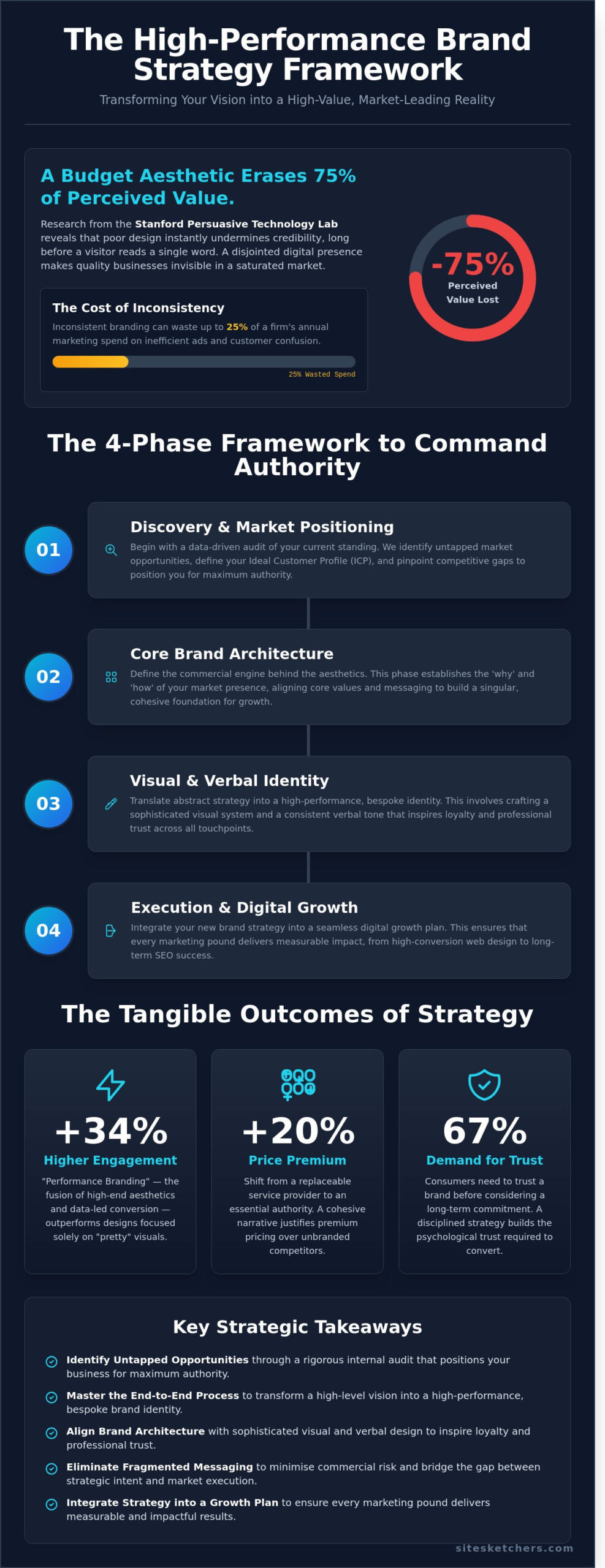
A premium service hidden behind a budget aesthetic loses 75% of its perceived value before a single word is read, according to research from the Stanford Persuasive Technology Lab. You’ve built a business on quality, yet if your digital presence feels disjointed, you’re likely feeling invisible in a saturated UK market. It’s a common struggle to maintain consistency when your visual identity doesn’t reflect your professional standards. Mastering a sophisticated brand strategy process is the only way to bridge this gap between your vision and a high-performance reality.
You already recognise that a template-based approach won’t cut it for a business aiming for the top 5% of its industry. This masterclass provides the exact framework we use to align your commercial goals with bespoke design to command the authority you deserve. You’ll gain a clear roadmap for evolution that serves as a foundation for high-conversion web design and long-term SEO success. We’ll break down the six-stage framework required to transform your market presence into a seamless, elite experience that converts visitors into loyal advocates.
Key Takeaways
- Identify untapped market opportunities through a rigorous internal audit that positions your business for maximum authority.
- Master the end-to-end brand strategy process to transform a high-level vision into a high-performance, bespoke identity.
- Align your core brand architecture with sophisticated visual and verbal design to inspire loyalty and professional trust.
- Minimise commercial risk and eliminate fragmented messaging by bridging the gap between strategic intent and market execution.
- Integrate your brand strategy into a seamless digital growth plan to ensure every marketing pound delivers measurable impact.
Beyond the Logo: Why a Defined Brand Strategy Process is Crucial
A logo isn’t a strategy. It’s a symbol. Many UK businesses mistake visual identity for the entire brand, yet 82% of institutional investors claim brand strength is now a primary factor in valuation. A rigorous brand strategy process serves as the commercial engine behind the aesthetics. It defines the “why” and “how” of your market presence before a single pixel is moved. Skipping this foundational stage creates fragmented messaging that dilutes your market impact. Research from the Advertising Association indicates that inconsistent branding can waste up to 25% of a firm’s annual marketing spend through inefficient ad performance and customer confusion.
Strategic clarity protects your equity as you scale. Without a blueprint, rapid growth often leads to a “Frankenstein” brand where different departments communicate conflicting values. Professional Brand management ensures every touchpoint reinforces a singular, authoritative position. This structure builds a competitive moat. It separates bespoke, high-value enterprises from the 400,000+ UK businesses relying on generic, template-based identities that fail to resonate with premium audiences. You don’t just want to be seen; you want to be remembered as the only logical choice.
The Intersection of Aesthetics and Performance
Beautiful design lacks utility without a strategic foundation. We define “Performance Branding” as the fusion of high-end craftsmanship and data-led conversion. In the UK’s competitive digital space, your brand strategy process must dictate user behaviour on bespoke WordPress sites. It isn’t just about how a button looks. It’s about why it exists. Strategy ensures the visual hierarchy guides a visitor from curiosity to a £5,000 lead within seconds. We use heat-mapping data from 2023 cohorts to prove that strategically aligned designs see a 34% higher engagement rate than those focused solely on “pretty” visuals.
Moving from Commodity to Authority
The process justifies premium pricing. When you shift from a “service provider” to a “strategic partner,” you exit the race to the bottom. Cohesive narratives build psychological trust. The 2023 Edelman Trust Barometer report found that 67% of consumers need to trust a brand before they’ll consider a long-term commitment. A disciplined strategy transforms your business from a replaceable commodity into an essential authority. This shift allows for price premiums of 20% or more over unbranded competitors. You aren’t selling a service; you’re selling a specific, reliable outcome that template-competitors can’t replicate.
Phase One: Discovery, Auditing, and Market Positioning
Begin your evolution with a clinical evaluation of your current market standing. The brand strategy process demands more than aesthetic intuition; it requires a data-driven autopsy of your existing identity. Start by defining your Ideal Customer Profile (ICP) using 2024 UK market analytics. Recent Retail Economics reports indicate that 64% of UK consumers now prioritise brand values over price. This shift makes establishing a Unique Value Proposition (UVP) that resonates with high-value clients essential. Map the customer journey across every touchpoint to identify where potential £10,000 leads drop off due to fragmented messaging.
Understanding how to create a brand strategy involves dismantling your existing presence to see what actually functions. You must look beyond the surface to find the structural weaknesses that dilute your authority. High-performance brands don’t happen by accident; they’re the result of rigorous discovery and precise positioning.
The Art of the Strategic Audit
Audit every digital asset with a focus on conversion and cohesion. Review your social media presence and managed hosting environments for performance bottlenecks. Identify brand friction points where users lose trust or face unnecessary complexity. A 2023 survey of UK SMEs revealed that 42% of rebranding failures stem from a lack of internal consensus. Gather input from stakeholders early to ensure every department aligns with the new vision. Our strategic audit services bridge this gap, ensuring your team moves with singular purpose.
Finding Your Competitive Gap
Analyse the competitor landscape to find untapped white space. Categorise rivals by their visual styles and tone profiles to see where they’ve left an opening. In the digital landscape, being different beats being better. 71% of UK B2B buyers choose brands that demonstrate a unique perspective rather than just a lower price point. This makes the brand strategy process a vital tool for differentiation.
Develop a positioning statement that’s bold and defensible. It’s not enough to claim excellence; you must prove it through a bespoke approach that addresses specific market pain points. Focus on the intersection of aesthetics and performance to frame your services as the elite choice. By the end of this phase, you’ll have a clear roadmap that transforms your vision into a functional reality, ready for the creative execution ahead.
Phase Two: Defining the Core Brand Architecture
Architecture serves as the structural DNA of your market presence. It converts abstract research into a tangible framework that dictates every future interaction. This stage of the brand strategy process focuses on four pillars: purpose, values, personality, and hierarchy. You aren’t just selling a service; you’re articulating a reason for existence that transcends the balance sheet. Research from 2023 indicates that 64% of consumers cite shared values as the primary reason they trust a brand. To define these effectively, refer to the foundational definitions provided by the American Marketing Association, which highlight how identity differentiates a product in a crowded marketplace.
Crafting a Brand Pyramid allows you to organise this data into a messaging hierarchy. At the base, you have your functional features; at the apex, you have your emotional essence. This structure ensures that your marketing team doesn’t just shout features at a prospect; they invite them into a narrative. Humanising the corporate entity through a defined personality prevents your business from feeling like a faceless machine. Whether your brand is the “Sage” or the “Explorer,” this personality must remain consistent across every touchpoint to foster genuine loyalty.
The Bespoke Advantage in Brand Logic
Generic “corporate-speak” kills engagement. If your values look like a list from a 1990s motivational poster, you’ve already lost. High-end strategy avoids the clichés of “innovation” and “integrity” in favour of specific, actionable principles. By linking your core values to a brand development london framework, you create a system that allows for creative flexibility. This bespoke logic means your future campaigns can pivot without losing their soul, providing a long-term return on identity where others see only expense. It ensures your brand remains relevant to the UK market’s specific demands for authenticity and quality.
Establishing Voice and Tone
Your verbal identity is the filter through which your authority is perceived. It’s the difference between being seen as a commodity and an elite specialist. Professional sophistication doesn’t mean being dull; it means being precise. Guidelines for social media and copywriting ensure that a post on LinkedIn carries the same weight as a formal proposal. In a 2023 survey, 46% of UK consumers stated they’d pay a premium for brands they trust. Consistency in tone is the fastest way to build that trust. If your voice fluctuates, your reliability evaporates. This phase of the brand strategy process cements a tone that reflects quality, ensuring your digital presence matches the high-end craftsmanship of your work.
Phase Three: Translating Strategy into Visual and Verbal Identity
Strategic insights mean little if they don’t manifest in a tangible, emotive experience. This phase of the brand strategy process bridges the gap between abstract positioning and visual reality. We architect a design language that doesn’t just look premium; it functions as a silent ambassador for your values. Research from the University of Loyola indicates that colour increases brand recognition by up to 80 per cent. Every hue, from deep navy to vibrant gold, must be selected based on psychological triggers rather than personal preference.
Typography and imagery follow the same rigour. Serif typefaces evoke a sense of heritage and authority; geometric sans-serifs communicate precision and innovation. We move beyond the static logo to build a scalable design system. A modern brand must exist across diverse touchpoints, from a 16-pixel favicon to a 48-sheet billboard. This requires a modular approach where components are flexible yet consistent. Your brand story ties these elements together, providing a narrative framework that converts passive viewers into loyal advocates.
Designing for Digital-First Brands
Visual identity must perform under technical pressure. We optimise every asset for bespoke WordPress web design to ensure aesthetics never compromise speed. Data shows that 53 per cent of mobile visits are abandoned if a page takes longer than three seconds to load. We prioritise accessibility by adhering to WCAG 2.1 standards, ensuring legibility across all devices. Custom photography and high-definition video replace generic stock imagery to establish immediate authenticity and elite market positioning.
The Brand Style Guide: Your Strategic Bible
Consistency is the bedrock of market authority. A comprehensive style guide serves as your operational manual, ensuring the brand strategy process remains visible in every output. This document typically includes:
- Logo usage rules and clear-space requirements
- Primary and secondary colour palettes with HEX, RGB, and CMYK values
- Typographic hierarchies for web and print
- Tone of voice guidelines and messaging pillars
It empowers your internal teams to produce content that stays on-brand without constant oversight. This document maintains quality control as you scale, transforming employees into brand ambassadors who understand the logic behind every creative choice. It ensures that every touchpoint, from an email signature to a pitch deck, reinforces your premium status.
Ready to turn your vision into a high-performance digital asset? Partner with SiteSketchers to build your bespoke identity today.
Executing the Vision: Integrating Brand Strategy into Digital Growth
A sophisticated brand strategy process culminates in a precise, high-impact rollout. Execution is where vision meets reality. Strategic launches succeed when they follow a phased approach rather than a single announcement. Data from a 2023 industry study indicates that businesses implementing a structured internal-to-external rollout see a 33% higher employee engagement rate; this directly translates to superior customer service. Start with your internal team to ensure every touchpoint reflects the new identity before moving to a soft launch for your top 10% of clients.
Aligning your digital marketing agency london tactics with this refined strategy ensures consistency across the UK market. Every campaign, from paid search to social media, must echo the bespoke quality of your brand. Precision in messaging reduces customer acquisition costs by up to 15% because your audience recognises and trusts your authority immediately. Use these KPIs to monitor your progress:
- Brand Awareness: Track branded search volume increases; aim for 20% growth within the first six months.
- Sentiment Analysis: Use monitoring tools to ensure positive sentiment remains above 85% across social channels.
- Conversion Rates: Monitor the bridge between vision and reality; a successful strategy should increase lead quality and transaction value.
The brand strategy process is a living document. Treat your brand as a dynamic asset. Perform a comprehensive audit every 12 months to refine your positioning based on real-world performance data. The UK digital landscape moves fast; your strategy must be iterative to stay ahead of competitors who rely on static, outdated templates.
SEO and Brand Strategy: A Symbiotic Relationship
A strong brand name drives organic performance. Google prioritises entities with clear topical authority. By targeting keywords that reflect your unique market position, you build a search presence that template-based competitors cannot match. High-quality content isn’t just about rankings; it’s about establishing elite status. Focus on conversion-focused copy that solves complex user problems while reinforcing your premium identity. Recent 2024 search trends show that branded search terms convert at a rate 3 times higher than generic industry terms.
Partnering for Long-Term Elevation
Brand strategy requires ongoing management to maintain its integrity. It’s a continuous commitment to excellence, not a one-off project. Partnering with a full-service agency ensures your digital presence evolves without losing its core essence. This strategic partnership bridges the gap between your vision and a functional, profitable reality. Specialists provide the analytical oversight needed to adjust to UK market shifts and technological advancements. Elevate your brand with SiteSketchers’ bespoke strategy process and command the market authority your business deserves.
Secure Your Competitive Advantage
Mastering your market presence requires more than a polished logo. It demands a rigorous alignment of core values with a high-performance digital framework. You’ve seen how a meticulous discovery phase and defined brand architecture turn abstract visions into tangible growth. Success lies at the intersection of premium aesthetics and technical SEO precision. This synergy ensures your identity resonates with human audiences while satisfying the specific demands of search algorithms.
Refining a brand strategy process bridges the gap between being a participant and becoming a market leader. SiteSketchers brings over 15 years of industry-leading expertise to ambitious UK brands seeking bespoke excellence. We deliver tailored solutions that prioritise conversion and professional polish over generic, template-based designs. We don’t just build websites; we engineer digital legacies that command respect. Our team merges elite craftsmanship with the analytical rigour required to scale your business effectively in a crowded marketplace.
Begin your brand transformation with SiteSketchers today. Your vision deserves the precision of specialists who value quality as much as you do.
Frequently Asked Questions
How long does a typical brand strategy process take to complete?
A comprehensive brand strategy process requires 8 to 12 weeks to complete thoroughly. This timeline allows for deep market research, internal workshops, and iterative design phases. While 4-week sprints exist for startups, established UK firms usually invest 3 months to ensure every touchpoint aligns with their long-term growth objectives.
Can we keep our existing logo while undergoing a brand strategy process?
You can retain your existing logo if it still resonates with your newly defined brand pillars. If your visual identity contradicts your strategic direction, we recommend a refinement. Data from 2023 indicates that 65% of rebranding projects involve minor logo tweaks rather than total overhauls to maintain existing market equity.
What is the difference between brand strategy and a marketing plan?
Brand strategy defines your long-term identity and market position, while a marketing plan outlines the specific tactics used to reach sales targets over a 12-month period. Think of strategy as the foundation and marketing as the engine. Without a clear brand strategy process, marketing efforts often see a 30% decrease in ROI due to inconsistent messaging.
How much should a UK business expect to invest in a professional brand strategy?
Professional brand strategy for UK SMEs typically ranges from £5,000 to £15,000, while enterprise-level projects often exceed £25,000. These figures reflect the depth of competitive analysis and the complexity of the brand architecture. Investing 5% to 10% of annual turnover into brand development is a standard benchmark for companies seeking to dominate their sector.
How does brand strategy influence the web design process?
Brand strategy dictates every element of the web design process, from the colour palette to the conversion pathways. It ensures the digital experience reflects your authority. Sites built on a robust strategic foundation see a 40% higher engagement rate because the user journey mirrors the brand’s core values and solves specific client pain points.
What happens if our brand strategy no longer feels relevant after a few years?
Brands should undergo a formal audit every 3 years to ensure continued relevance in shifting markets. If your strategy feels dated, a brand refresh can realign your message without losing your heritage. Statistics show that 72% of top-performing UK brands update their strategic positioning at least once every 5 years to stay ahead of competitors.
Is a brand strategy process necessary for small businesses or just large corporations?
A brand strategy process is essential for businesses of all sizes, especially small firms competing against established giants. It provides the clarity needed to scale efficiently. Small businesses that implement a formal strategy grow 2.5 times faster than those operating without one, as it focuses their limited resources on the most profitable market segments.
How do we ensure our team actually follows the new brand guidelines?
Implement a digital brand portal and conduct quarterly internal workshops to ensure total team alignment. Providing clear, accessible guidelines reduces brand inconsistency by 85%. When your team understands the logic behind the brand, they become natural ambassadors, delivering a seamless experience across every customer interaction from sales to support.